The Ensigns Armorial of
The International Association of Clan MacInnes
By Donald MacInnes of Cumbernauld
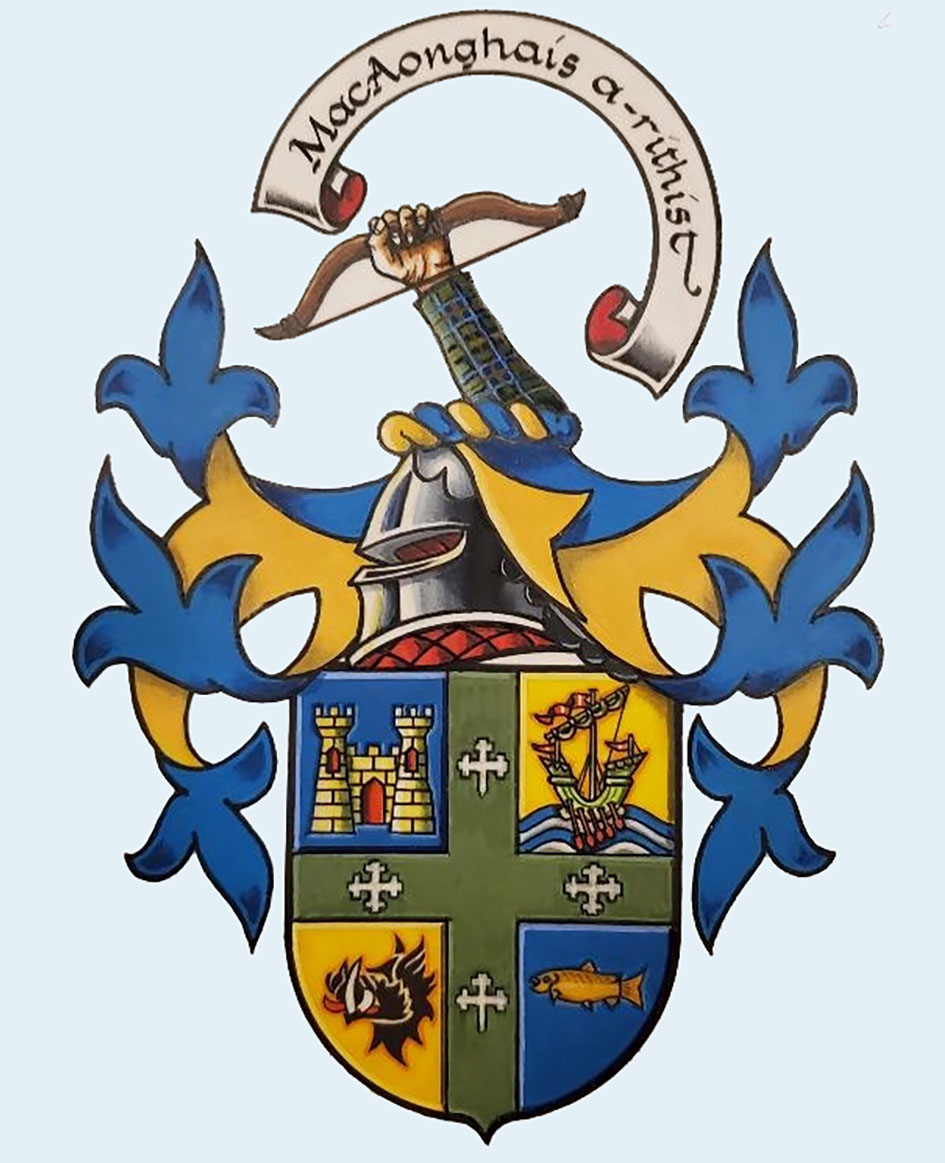
Robin O. Blair, LVO, WS, Lord Lyon, King of Arms, Scotland has approved the first Ensigns Armorial for the International Association of Clan MacInnes. The Arms are now matriculated.
The Arms are based on the history and traditions of Clan MacInnes and draw on the heraldic practice of the West and Isles of Scotland - the home of Clann Aonghais - the Sons of Angus.
Our Ensigns Armorial is an account of the history and traditions of Clan MacInnes they are not the chronicle of an elite - but the story of the Gael the Highlander!
The Shield
West Highland heraldry generally quarters the Shield. In this instance the Shield is quartered by a green cross containing four crosslets. The cross and crosslets remind us of Clan MacInnes ancient connections with St Columba and the holy Isle of Iona for centuries Iona was the royal burial island of the kings and clan chiefs of Scotland.
The MacInneses vaunt connections with the great saint of Scotland and the name MacInnes was the predominant surname on the Isle of Iona in the past.
Iona is still revered as a sacred place of pilgrimage to the world.
As already stated, it is common in the tradition of West Highland heraldry to quarter the Shield.It is also common to insert one of four symbolic charges or Highland heraldic symbols in one of the quarters.The Shield of the International Association of Clan MacInnes incorporates two of these traditional charges; the Lymphad or West Highland galley and the mysterious symbol of the salmon; both charges having ancient associations with Clann Aonghais.
The Castle
The charge in the first quarter of the Shield is the unusual heraldic castle of twin towers unique to the MacInneses.
The castle primarily associated with Clan MacInnes is the Castle of Kinlochaline in Morvern. Tradition tells us that the Dubh Chall, a dark lady of Clan MacInnes who commissioned the construction of the original castle, made in payment to the builders, a huge quantity of butter equal to the volume of the castle. This unorthodox payment gave the castle its Gaelic name of Caisteal am Ime or the Butter Castle.
Kinlochaline Castle was the traditional seat of the chiefs of Clan MacInnes.
A MacInnes garrisoned the castle when it was besieged and burnt by Alasdair MacColla during the campaigns of Montrose.
The Celtic title of the hereditary keepers of Dunstaffnage Castle on the Firth of Lorn was MacAonghais.
The Lymphad
The lymphad or West Highland galley is the versatile Gaelic "birlinnof" the sea-going clans and the sea kingdoms of the Scots.
The lymphad on the Shield reminds us of the sea power of Clan MacInnes and the clan's influence over the busy sea-lanes of the Hebrides. The clan's possession of Islay and Jura provided the MacInneses with a unique overview of naval and trading movements for commerce, protection and war.
In the time of Somerled the birlinn was a vital instrument against the marauding Vikings and in the era of the Lordship of the Isles the Highland birlinn spread the revived culture of the Gael throughout Gaeldom.
The MacInneses, as the principle clan of Morvern, Ardgour and Ardnamurchan overlooked the prime sea route through the Sound of Mull and its environs.
The five oars depicted on the Lymphad symbolize the five MacInnes families who left Morvern to settle on the Isle of Skye.
The Salmon
The salmon is a heraldic symbol of great antiquity and is one of the four traditional charges of the West Highlands. For the MacInneses the salmon denotes the omen of good fortune sought by the great Gaelic warlord Somerled in his decision to lead the subsequent victorious MacInneses of Morvern against the Lochlannthe Vikings.
It is said that a chiefless Clan MacInnes sought the generalship of Somerled to lead them against the Vikings. Somerled declared that he would consent to lead the MacInneses, if, as a good omen, he caught a great salmon in the pools of the river Aline this he did. Withal he exhorted the MacInneses to be of good courage, and to do as they would see him do, so they led the charge. The first whom Sommerled slew he ript up and took out his heart, desiring the MacInneses to do the same, because the Danes were not Christians. So the Danes were put to the flight; many of them were lost in the sea endeavouring to gain their ships; the lands of Mull and Movern being freed at that time from their yoke and slavery.
In the oral traditions of the clan Somerled is claimed as a descendant of the Cenel Aonghusa - the early MacInneses of the Isle of Islay.
The Boar
The boar is second only to the rampant lion in the use of animals that appear in Scottish heraldry. The boar features on the Arms of many clans. Indeed, the late Lord Lyon, Sir Thomas Innes of Learney, decreed a boar's head as the true Crest for MacInneses.
The unmatriculated Arms of the Reverend John MacInnes of Crathie give a demi-boar as a Crest and the matriculated Arms of MacInnes of Carradale have a demi-boar holding a bow and arrow while sporting a MacInnes clad tartan plaid.
The black boar's head in the fourth quarter of the Shield takes us back to the cradle of the Scottish nation in ancient Dalriada and the origins of Clan MacInnes. The sixth century origin story claims that the progenitor of the MacInneses was Angus, one of the three sons of Erc, who colonised Scottish Dalriada from Ireland. Angus of Dalriada ruled the islands of Islay and Jura. The early 7th century Scottish history of the Senchus Fer n'Alban details the kindred of the Cenel Aonghusa on the Isle of Islay.
The carving of a wild boar can be seen on the summit of the inauguration hill of Dunadd in Argyll on which the rulers of Dalriada were ordained.
The Crest
The MacInneses are celebrated in history for their prowess as archers. It was on the Isle of Skye that this fame achieved greatest prominence through the legendary archer Niall aBhogha and his MacInnes family who became bodyguards and instructors in archery to Clan MacKinnon. The feats of Niall aBhogha are the material of myth.
The Crest is unique in that the sleeve of the archer is of green MacInnes tartan, thus, deeming the tartan proper in heraldic terms and putting this MacInnes tartan under the jurisdiction of the Court of the Lord Lyon. There is no official register of tartans.
The Motto
The Gaelic "MacAonghais a-rithist" or "Again MacInnes" was the motto adopted by the founders of the Clan MacInnes organization.